
The rental market in 2026 has fundamentally shifted. A construction boom has handed power back to renters, vacancy rates have hit modern highs, and the generation now driving leasing decisions, Gen Z, grew up fully digital, deeply values-driven, and unwilling to compromise on their living experience. For building owners and operators, the question is no longer just “how do we fill units?” It’s “how do we build a home people genuinely don’t want to leave?”
The answer lies in understanding what today’s renters actually prioritize and then delivering it. Across every major trend shaping the 2026 rental market, from on-demand convenience and tech-native experiences to sustainability, community, and access over ownership, TULU was built to meet renters exactly where they are. It’s not a coincidence, it’s the model.
Based on research from the National Apartment Association, Harvard’s Joint Center for Housing Studies, AppFolio, Apartments.com, Zillow, Matterport, and others, here’s what’s actually driving lease signings, renewals, and referrals right now.
The Market Context: Renters Have the Leverage
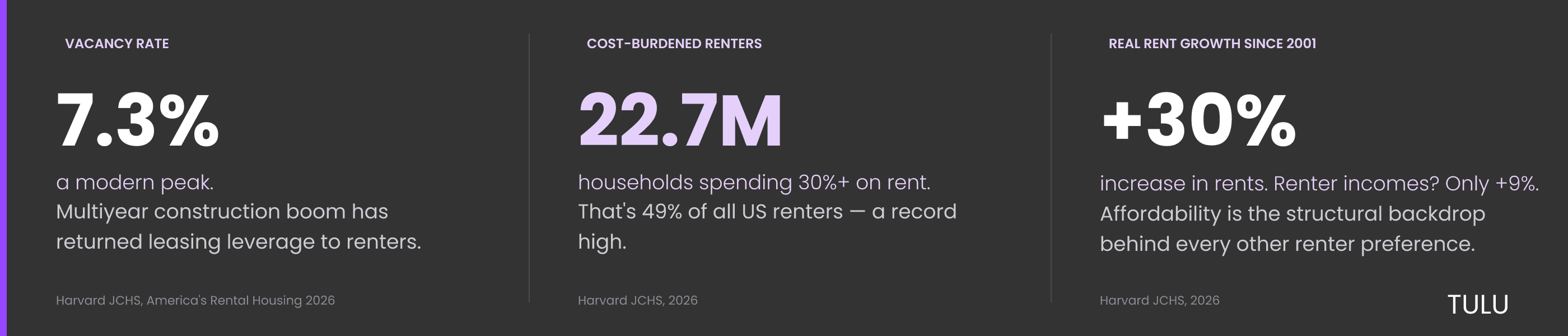
National vacancy rates have reached a modern peak of 7.3%, driven by a multiyear wave of multifamily construction. Rent growth has flatlined, professionally managed apartments saw a slight 0.6% year-over-year decline in Q4 2025, per Harvard’s America’s Rental Housing 2026. In oversupplied Sun Belt markets like Austin and Jacksonville, concessions of one to two free months are commonplace.
Renters have choices and they know it. But affordability remains a structural challenge: a record 22.7 million renter households, 49% of all renters, are cost-burdened. Since 2001, rents have risen 30% in real terms while renter incomes have grown only 9%. Renters aren’t just looking for a nice apartment. They’re looking for genuine value and they’re willing to reward the buildings that deliver it with their loyalty.
Affordability and Transparency Come First
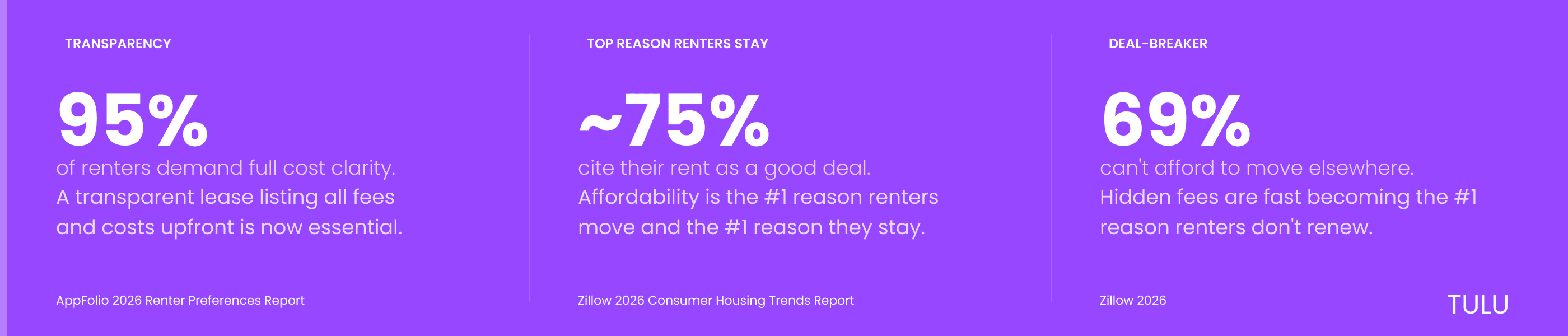
Zillow’s 2026 Consumer Housing Trends Report, based on a survey of over 24,000 renters, found that affordability was simultaneously the top reason renters move and the top reason they stay. But affordability alone isn’t enough — renters demand full transparency about what they’re paying. In AppFolio’s 2026 Renter Preferences Report, 95% of residents said a transparent lease-signing experience that clearly details all fees and costs is essential. Gen Z renters in particular want to see the full all-in monthly cost before they even consider a tour. Hidden fees are fast becoming deal-breakers.
A Digital-First Experience Is Now the Minimum
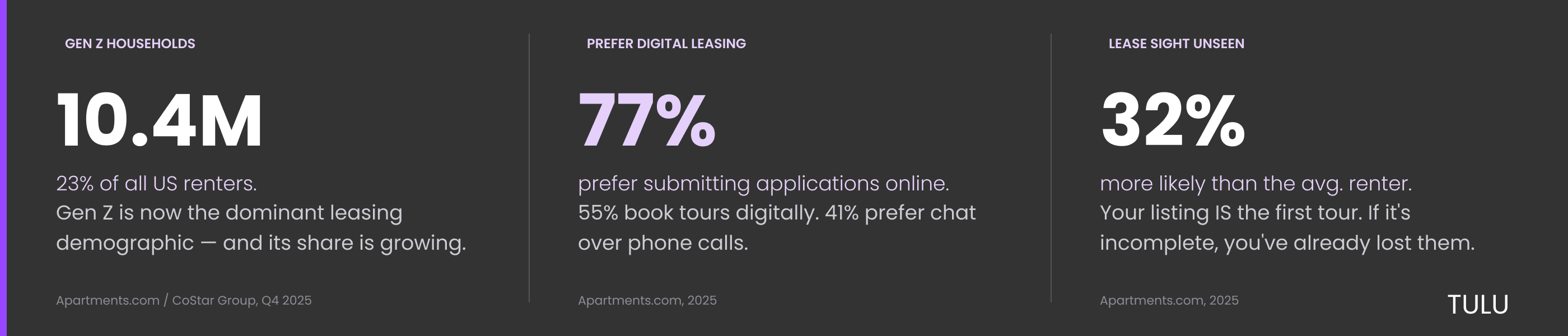
Gen Z now heads 10.4 million renter households and accounts for 23% of all renters, according to Apartments.com and their share is only growing. The data tells the story clearly: 55% prefer to book apartment tours online, 77% prefer submitting applications digitally, and Gen Z renters are 32% more likely to lease sight unseen than the general renter population. Buildings that can’t be fully evaluated from a phone screen are losing leads before a single conversation takes place.
AI-powered leasing assistants have moved from novelty to infrastructure. AppFolio found that 86% of residents who interact with an AI concierge report satisfaction with communication, compared to 77% of those without, a meaningful gap in a market where reputation is everything.
Smart Home Tech, WFH Infrastructure, and Practical Amenities
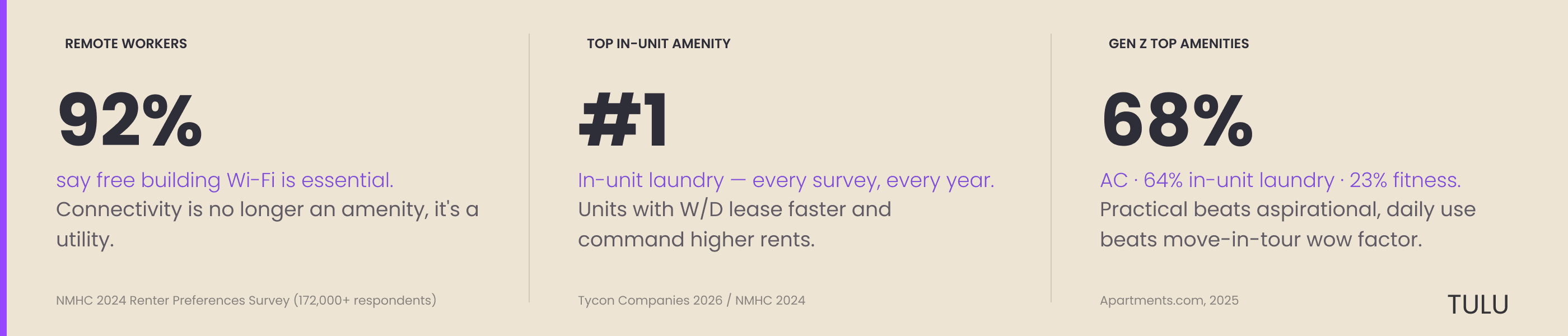
Smart home technology has crossed the threshold from competitive advantage to expected standard. Keyless locks, smart thermostats, and integrated lighting rank among the top in-unit features renters want. The NMHC’s 2024 Renter Preferences Survey found that 92% of remote workers consider free building Wi-Fi essential, and secure 24/7 package management has become one of the most appreciated amenities in any building.
Remote work has also permanently restructured what renters need from a building. Demand for “third spaces” — co-working areas with private Zoom rooms, ergonomic seating, and reliable connectivity — is intense and growing. Buildings offering this infrastructure are seeing stronger leasing performance among the remote professional demographic.
On amenities broadly, the data from Tycon Companies is direct: the amenities that drive satisfaction and retention are ones that support daily routines, not ones that look good in marketing photos. In-unit laundry consistently ranks as the most requested amenity.
Pets, Wellness, and Sustainability Are Leasing Factors
Forty-four percent of Gen Z renters live with a pet, per Apartments.com. Reuters reported in June 2026 that as homeownership feels increasingly out of reach, young renters are centering their lives around their pets and making housing decisions accordingly. Buildings that make pet ownership genuinely easier see longer tenancies and stronger referrals.
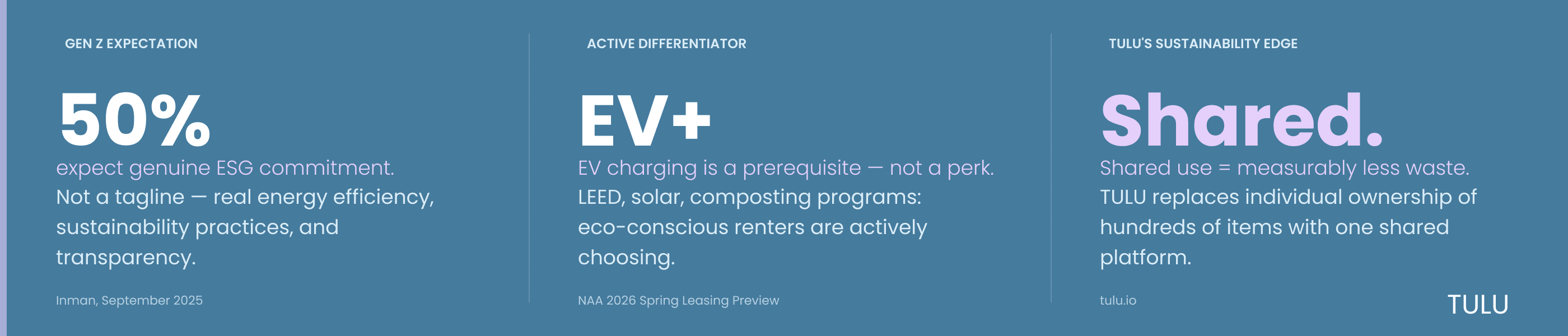
On wellness, renters’ definition has expanded well beyond the gym — air and water filtration, mental wellness programming, and recovery amenities are gaining real traction in premium communities. And on sustainability, 50% of Gen Z renters now expect their buildings to demonstrate genuine ESG commitments, per Inman’s analysis. EV charging, energy-efficient systems, and visible green certifications are actively differentiating buildings in competitive markets — and buildings without them are being passed over.
Post-pandemic renters are actively seeking buildings with genuine community culture, not just proximity to other people, but spaces and programming that foster actual connection. As the NAA’s 2026 Spring Leasing Preview notes, purpose-driven engagement around sustainability, inclusivity, and mental wellness matters deeply to Gen Z, and communities aligned with these values see stronger resident engagement and lease renewals.
The National Association of Realtors found that roughly 90% of Gen Z and Millennial renters would pay more for a walkable community. Proximity to grocery stores, transit, and workplaces consistently outranks square footage in their priorities. And flexibility matters too: Gen Z renters are 134% more likely to live with roommates, and short-term leases, furnished units, and flexible deposit options are active differentiators in this market.
The Biggest Opportunity Gap: Resident Services
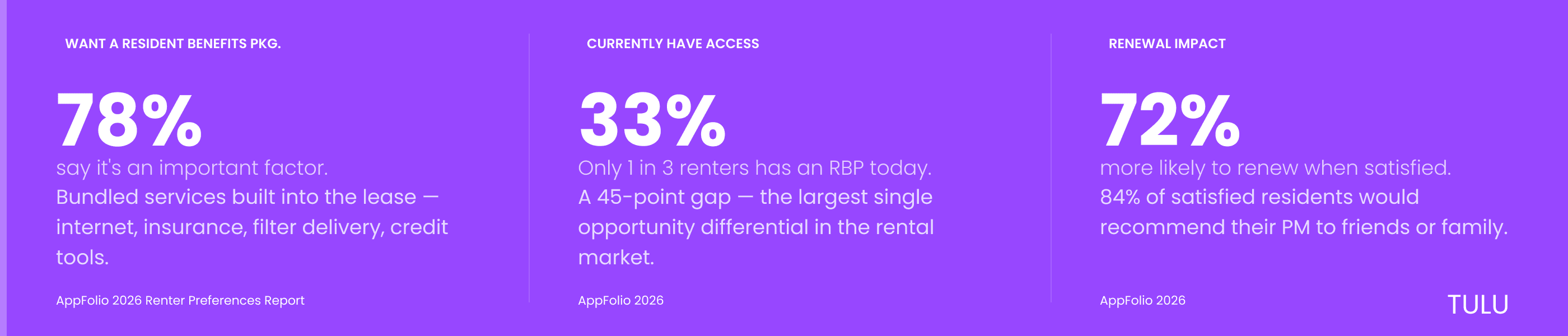
One of the most significant findings in AppFolio’s 2026 report is the gap between what renters want and what they have. Seventy-eight percent of renters say a Resident Benefits Package — bundled services like group-rate internet, renters insurance, air filter delivery, and credit-building tools — is an important factor when choosing a home. Yet only 33% of renters currently have access to one. That 45-point gap is one of the largest opportunity differentials in the entire rental market. Satisfied residents are 72% more likely to renew, and 84% say they’d recommend their property manager to friends or family. In a market where organic referrals are the highest-quality lead source available, this isn’t a soft metric, it’s a business strategy.
How TULU is Meeting the Modern Renter Where They Live
Running through virtually every trend in this report is a common thread: renters want everyday convenience, access over ownership, sustainability, community, and technology, woven into the fabric of their building, not bolted on as an afterthought. This is precisely the problem that TULU was designed to solve, and it’s why TULU’s model is unusually well-aligned with the direction the market is moving.
Born at MIT’s DesignX incubator and now operating in more than 60 cities across North America, the UK, and Europe, TULU is an in-building smart amenity platform that gives residents on-demand access to the everyday items they actually need — right inside their building, available 24/7, through a mobile app. Think vacuum cleaners, power tools, gaming consoles, Dyson hair dryers, e-scooters, air mattresses, print services, and everyday consumables — all bookable and retrievable in minutes without leaving the building.
What makes TULU particularly relevant in 2026 is how comprehensively its model addresses the specific preferences renters are expressing:
Everyday convenience, not showpiece amenities. TULU’s offering is built around real daily friction points, the items residents need on a Tuesday night as much as a Saturday morning. This is exactly what the data shows matters most. The NMHC’s 2024 Renter Preferences Survey explicitly identified the “three Cs” driving leasing decisions as comfort, convenience, and connectivity. TULU delivers all three through a single platform that converts underused building space into a curated, accessible micro-store.
Access over ownership — the defining renter preference. Gen Z and Millennial renters have grown up in a world where you stream instead of buy, ride-share instead of own a car, and prioritize experiences over possessions. Seventy-two percent of Gen Z renters believe renting is smarter than buying, according to Inman’s 2025 analysis and their logic extends beyond real estate to how they relate to household goods. TULU operationalizes the sharing economy at the building level, giving residents access to high-quality items on demand without the burden of ownership, storage, or moving stress. For the highly mobile young renter who changes cities every 18 months, this isn’t just convenient — it’s the preferred way to live.
A genuine sustainability contribution. TULU’s shared-use model is structurally aligned with the ESG values that 50% of Gen Z renters now expect from their buildings. By replacing individual ownership of hundreds of household items with shared access, TULU meaningfully reduces each building’s environmental footprint and helps operators meet sustainability commitments in a measurable, demonstrable way, not through a marketing statement, but through a platform that changes actual consumption patterns.
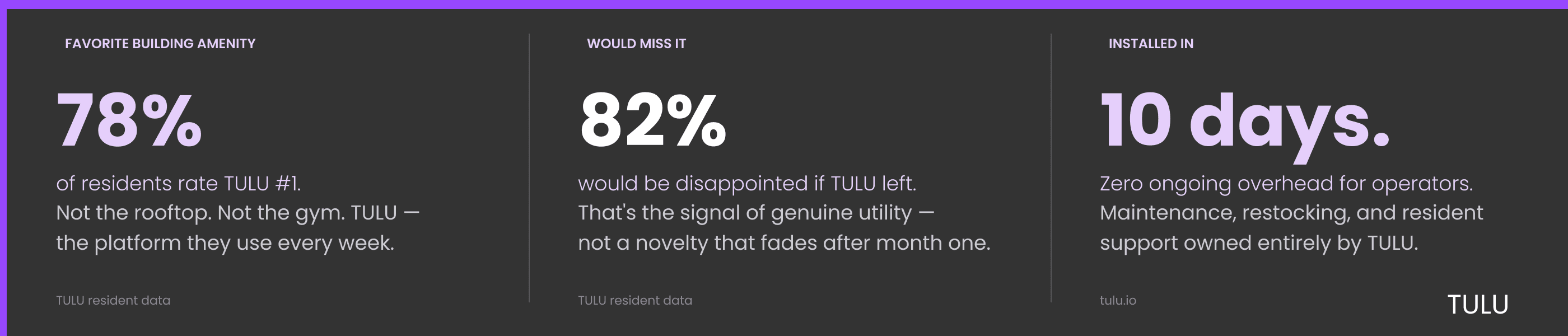
Community built through daily interaction. Unlike a rooftop lounge that residents visit twice a year, TULU creates natural, recurring touchpoints for community-building every time a resident uses it. Residents bring friends down to check it out. They recommend it to new neighbors. The platform generates the kind of organic, word-of-mouth community culture that property managers spend enormous effort trying to create through programming. TULU’s own data bears this out: 78% of residents rate TULU as their favorite building amenity, and 82% say they would be disappointed if it were no longer available, numbers that reflect genuine resident loyalty, not passive indifference.
Technology-native experience. TULU’s mobile-first, AI-powered platform allows residents to browse, book, and pick up items in minutes through their phones, exactly the frictionless, app-like experience that Gen Z and Millennial renters expect. The platform also continuously analyzes real-time usage data to refine and tailor its offerings to the specific needs and preferences of each building’s residents, giving operators behavioral insights they’ve never had access to before.
Speed and simplicity for operators. For property managers navigating tight margins, rising operating costs, and the pressure to differentiate without overspending, TULU offers a high-impact solution that can be installed in as little as 10 days, with ongoing maintenance handled entirely by TULU’s team. By transforming neglected square footage into a premium community feature, this model eliminates the need for upfront capital or added management burden, while simultaneously unlocking a sustainable channel for ancillary revenue through a performance-based sharing structure. Leading operators including Greystar, Bozzuto, and Blackstone have already recognized what the data is showing: residents who have TULU stay longer, refer more, and feel more connected to the communities they live in.
The broader lesson from TULU’s model is an important one for the industry: the most effective amenity strategies in 2026 are not about adding more but about adding smarter and identifying the actual friction points in residents’ everyday lives and solving them in ways that are genuinely used, genuinely valued, and genuinely drive the metrics that matter.
The Building That Wins in 2026
Today’s renters aren’t asking for the impossible, they just want to feel like their building works for them and is designed with their actual daily life in mind.
Buildings that deliver on these fundamentals — affordability, transparency, technology, genuine convenience, wellness, sustainability, and community — are the ones attracting the best residents, earning the best reviews, and seeing the strongest renewal rates.
The amenities arms race is over and the resident experience era has begun.